What is Different Now?
Information networks
Artificial Intelligence is certainly the next paradigm shift in the world of information, yet it largely stands out from existing technologies such as television, radio, computers or the internet. Unlike all the others before it, AI is not a medium for humans to communicate.
Historically, information has always travelled from one human to another. Books and documents were always written for other humans to read. Radio shows were broadcast to human audiences. There was simply no alternative. This is no longer the case.
Consider a group of people who want to communicate with each other. For this to happen, information must be transferred from (at least) one person to another. The medium is not important - radio broadcast, television show, physical document, email, etc. - are all equally valid. The key point is that regardless of whether or not technology is involved, the actors of this network have always been human. The technology is merely the connecting edge.
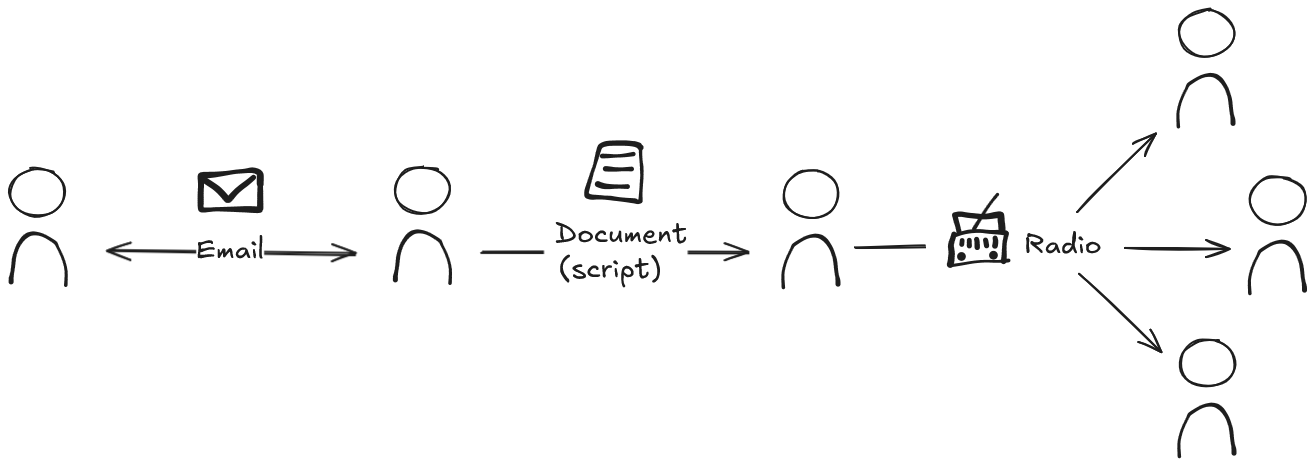
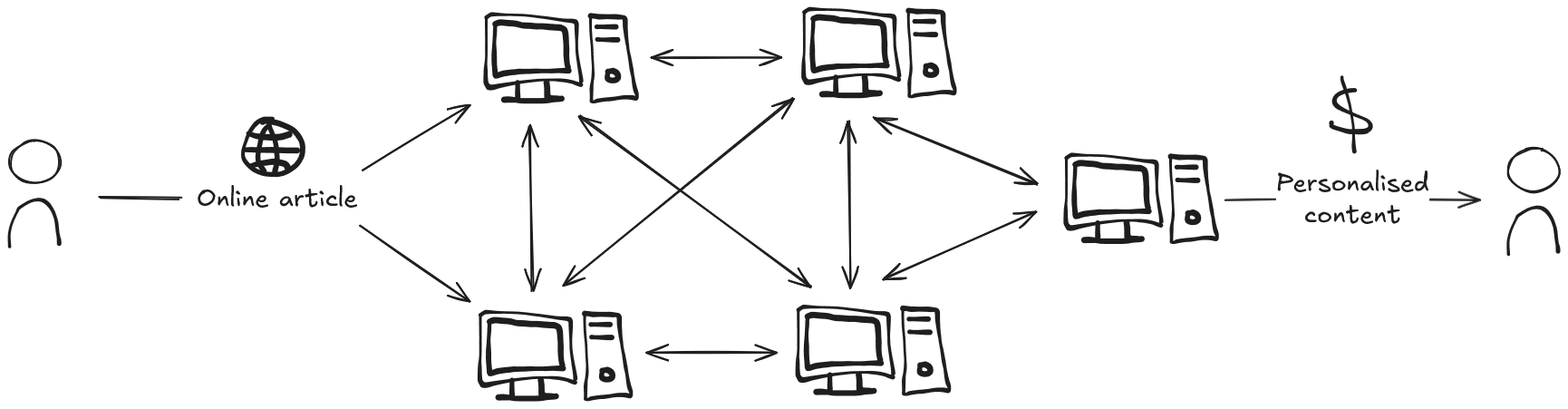
With the emergence of AI we are witnessing an unprecedented change. The technology is establishing itself as a fully fledged member of the information network. Not just a connecting edge.
Up to this point, technology has not been capable of making decisions by itself. It could not create any new information, nor could it decide on who should receive it. For it to be useful, a human presence has always been required. AI changes this dynamic. For the first time in history we have systems which can generate data, and make decisions by themselves, without the need for human input.
To illustrate why this is significant, picture the following scenario. Online outlets are reporting on the latest news. An AI agent is scraping the web and observing; it is analysing whether what is being said is relevant to its own goals. It identifies that there are reports from many sources suggesting that a war is about to break out. Based on this information, it decides to publish fearmongering articles of its own, and engage in discussions on social media. It wants to use this as bait for engagement. Another agent reaches a conclusion through sentiment analysis that a shift in the market is imminent. It decides to sell its stocks and push its own narrative online. This creates a cascading effect as other AI systems recognise what is happening, and also take action accordingly. There is a vicious loop in place - systems take action based on a particular state of the world, which by definition affects this very state, causing other systems to react. This could all take place within a matter of seconds, without any human intervention, and quite likely even without their awareness.
What comes next?
At the moment, we humans still play a crucial role in these information networks, but this may change. As AI becomes more “intelligent” we will likely be pushed out, and networks without any human members could very well emerge. We really need to think about the consequences that this may have. Who takes accountability for decisions made without any human involvement? How are those decisions even reached?
As the AI models get larger in size, consume more data, and their algorithms grow in complexity, the decision making frameworks will become incomprehensible to humans - that is, if they are not already. We will thus lose the ability to understand how the algorithms reached certain conclusions, allowing them control our lives without comprehension. It should go without saying that this has the potential to become very concerning if not regulated accordingly. Take a minute to think about these questions. Are you aware that your life (and much of the world) is being controlled by algorithms? Do you know how these algorithms work? Do you care? What if the algorithm was replaced by a human? One whose identity you could never know, who watches you all the time, and who controls what information reaches you. How would that make you feel?
Nonetheless, it is still the humans who are developing this next wave of technology. It is our responsibility to understand what we can do to leverage our agency, and how to shape AI into a tool which best serves humanity.
At the end of the day, a technology is not inherently evil - that is decided by how it is used. For example, a radio could be used to entertain and uplift citizens, or to spread the propaganda of a totalitarian regime. AI is no different in that regard. It could be used to detect cancer cells in x-rays with an accuracy higher than any medical professional, or to create a mass surveillance program with facial recognition to control the population. The choice is ours.
Unfortunately, humans are not infallible, and there is a danger that we make the wrong choices. The whole world is rarely ever in total agreement on anything, and AI will be no exception.
In fact, it may not even be the AI systems themselves which disrupt the world’s information networks. We may do it ourselves first. As technology advances, governments and organisations around the world will likely push for their own products and algorithms, and be opinionated about how they are used and regulated. They may also begin to take more responsibility and ownership over their data, tightly controlling who can access it and use it for training. For example, it may be in China’s best interest to not allow the United States to access any of the data or algorithms which were used for training their newest models (and vice-versa). This conflict of interest becomes all the more apparent when one considers the potential of AI within military or government applications. Once the first domino falls, the outcome might not be reversible. What we currently know as the World Wide Web, may very well become a set of disjointed cocoons.
editor’s note: [The US government, citing national security authorities, has issued an export control directive to suspend all access to Fable 5 and Mythos 5 by any foreign national, whether inside or outside the United States][https://www.anthropic.com/news/fable-mythos-access]
editor’s note #2: EU moving away from US based technology